As the leaves change color for fall, and the season gets spooky for Halloween, the spookiest thing is thinking about how all bat species in Ohio are either endangered, threatened, or a species of concern. One of those is the silver-haired bat (Lasionycteris noctivagans), a medium sized bat weighing 8-12 grams and is identified by the distinct silver tipped fur on its back, hence their common name. There is something special about this species; they have been heard singing in our forests.
When it comes to bat communication, their calls are typically ultra sonic (above the human threshold of 20khz). Bats create acoustic mental maps of their surroundings – a sort of sight through sound – through echolocation, helping them find food or kin. Echolocation calls range from search phase navigational calls to feeding buzzes that allow them to pinpoint their prey. Paying attention to this type of call on a spectrogram, a visual representation of sound, can be indicative of foraging activity. This can give clues about habitat quality. Some bat social calls sound like chirps and can be heard by the human ear – a squeak or “cheep” type sound.
Audio recordings are the most useful tool when studying bats. Today, biologists use ultrasonic microphones and specialized software programs that identify frequency and unique structures in recordings that identify species. Larger bats typically emit lower-frequency signals, whereas smaller bats produce higher-frequency signals. The structure of a signal can provide insight into behavior. Search phase recordings look different from a feeding buzz and different from a song. Structure is how the silver-haired bat song was discovered.
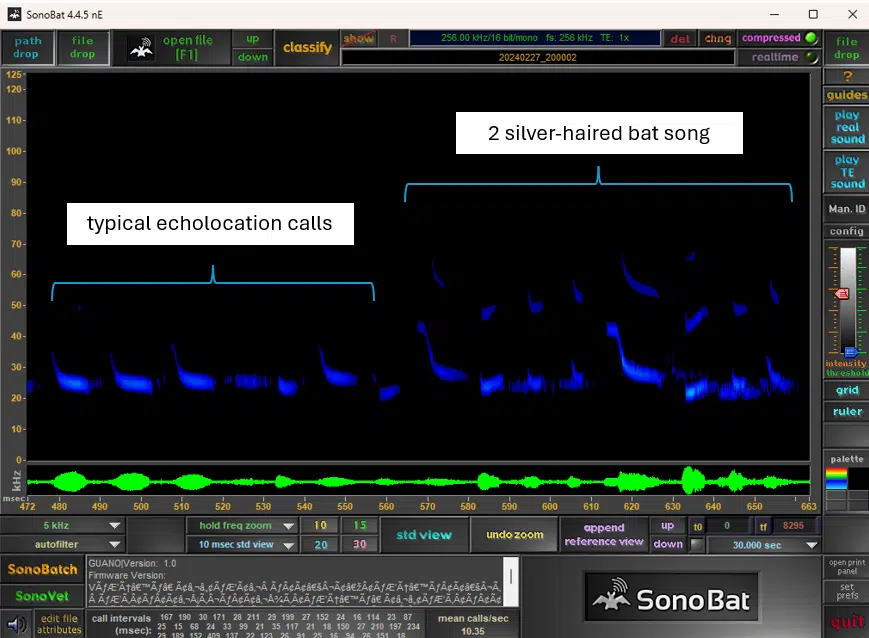
Song as a form of communication is best studied in birds and relatively new in bats. By definition, a song is a repetitive, patterned, and complex sound typically found in the context of courtship or mating. Because bats use ultrasound to navigate and forage, singing is an uncommon behavior. The silver-haired bat is one of two known North American species that sing, the other being the Mexican free-tailed bat (Tadarida brasiliensis). So far, silver-haired bat song had only been documented in British Columbia (BC) and the northwestern US (WA, ID, and MT), until now.
We have heard this bat’s song in our forests, which is why conservation biologist Mike Watson is in collaboration with Jonathan Townsend, bat biologist at Environmental Design & Research in New York. Audio recordings from Holden natural areas will be a part of a larger study with multiple partners that will track the presence of the silver-haired bat song in the eastern US. This work will help further the knowledge in bat communication and allow us into their world – why do they sing? It will teach us more about their social behavior and let us know just how rare songs are among bat species that could lead to more research opportunities.
Whether you fear them or are captivated by them, their biology is undeniably fascinating. With a heartbeat that ranges from 4-6 bpm during hibernation, up to 1000 bpm during flight and back down to a resting rate of 200 bpm, they are truly extraordinary creatures.
As our only true flying mammal, bats are essential to our landscapes, ecosystems, and economies. They feed on insects, controlling their populations, which protects young trees from insect damage. They also consume immense amounts of agricultural pests and insects able to spread vector-borne diseases (like mosquitoes) – protecting our crops and public health.
This fall, some silver-haired bats will be migrating south for warmer weather, while some will stay put and hibernate alone in tree cavities, leaf litter, or wood piles. Those that migrate fly over 900 miles each year!
A good-quality mature forest is crucial to this bat’s habitat. Features like ponds, streams, and standing dead trees are great for hosting these guys. Their important role in our ecosystem helps ensure the health of our forests and keep the balance in the food chain.
There are various ways to support declining bat populations. Both small and large actions have a meaningful impact. Some small ways include planting native plants (night-blooming plants are a plus) and creating leaf litter or brush piles to encourage insects (bat food). You can also help prevent predation on bats by reducing outdoor lighting; low lighting makes them less visible to predators. Another idea is to install a bat box on your property; this will provide a safe place for pups raised in the summer. Some large-scale methods include sustainably managing your forest with bats in mind. This means ensuring your forest has large diameter trees, large standing dead trees, and areas where these exist in sunny spots. Working with a professional is encouraged to ensure management activities, like thinning, avoid roosting season for bats.
Bats have a history of getting a bad reputation. They are associated with negative superstitions around the world, but the services they provide for our environment are important. They are more than how they have been portrayed; they are keystone species worth understanding and protecting. This season let’s see bats differently.
Photo credits
Header photo: Silver haired bat by David Roberts via iNaturalist
Here’s more to explore

September 4, 2026
New Species of Diatom Discovered in Stebbins Gulch
Walking along a rocky creek at the bottom of a steep, shady canyon, ancient trees towering overhead, a surprising coolness on the breeze — a traveler might feel like they’re...
Read more
January 6, 2026
Life in the Winter Forest
Take a stroll through the forest at the Holden Arboretum on a cold winter’s morning — the trails are open year-round — and the quiet stillness might trick you into...
Read more
September 4, 2025
Moths on the Move
My job at Holden Forests & Gardens as the propagator is to produce and take care of baby plants. That often involves going out into the gardens and natural areas...
Read more
August 28, 2025
Veterans Find Healing in the Beehives at Cleveland Botanical Garden
Our fascination with bees is as old as time itself. The Paleolithic cave art in Spain shows honey hunters perched on cliff faces 10,000 years ago. In ancient Egypt, the...
Read more
May 5, 2025
How Data-Driven Conservation Fledged 30,000+ Native Birds at Holden Arboretum
The bluebird program at Holden reached a milestone in 2024: 60 years of continuous conservation and data collection. This history is marked by clear successes in the effort to support...
Read more
March 19, 2025
Dabblers & Divers: Birding for Spring Waterfowl and Similar Species
With spring just ahead temperatures are rising, days are getting longer, and ice is melting. For the various species of waterbirds in northeast Ohio this means access to important resources...
Read more
September 16, 2024
Best Practices of Backyard Bird Feeding
Backyard bird feeding is a popular and enjoyable activity for many nature enthusiasts. It offers a chance to observe and appreciate local wildlife up close. However, while bird feeding can...
Read more
July 17, 2024
Save the Hymenopterans (Bees, Wasps and more!)
Hymenopterans are the group of insects including bees, wasps, ants, and sawflies. “Sawfly” is the name applied to all but one group within the hymenopterans, making this group paraphyletic –...
Read more
June 3, 2024
An Update on our Feathered Friends
Within the next few weeks our male red bishop weaver birds will have their breeding plumage completely grown in and be ready to begin their summer courtship displays. Their display...
Read more