Holden’s Working Woods featured in global report on botanical gardens and ecosystem restoration
November 9, 2026

Holden Forests & Gardens is one of dozens of institutions featured in a new report from Botanic Gardens Conservation International (BGCI) on how botanical gardens and arboreta can help restore ecosystems at a global scale.
The publication, Scaling Ecosystem Restoration Through Botanical Garden Networks, published in September 2026, was developed through the New York Botanical Garden’s Nurturing Nature Initiative. It’s a collection of reports and case studies from gardens and partner organizations around the world; their work ranges from rare-plant reintroductions in Italy and genomic seed sourcing in Australia to community seed collection in Colombia and Indigenous-led forest protection in Vanuatu. Holden’s contribution, written by Working Woods Hub Manager Rebecah Troutman and Director of Research Katie Stuble, describes how the Working Woods Hub is teaching landowners to use active management to restore young forests in northeast Ohio.
A Look at Global Gardens
There are more than 3,600 botanical gardens around the world. Together, they’re growing more than 30% of all known plant species. Some house seed banks and herbarium collections, many have educators on staff, and most know how to propagate a wide range of native plants, including ones commercial nurseries wouldn’t carry. These are exactly the skills and expertise you’d want put toward large-scale ecosystem restoration efforts — and these are exactly the skills these efforts often lack.
To understand what determines if and how gardens use these skills for restoration, NYBG and BGCI surveyed institutions on every continent where botanical gardens operate. Of the 73 institutions that responded, funding was the most commonly cited barrier (74%), followed by staff time and lack of support for long-term monitoring. Notably, only 12% cited lack of technical expertise. The authors conclude that gardens already know how to do ecosystem restoration work, but they lack the resources to carry it out — especially sustained resources to support work over the decades that ecosystems can need to recover.
Working Woods: a Forest Built for Learning
The Working Woods Learning Forest is a 70-acre demonstration forest at the Holden Arboretum where staff from Holden’s research, conservation, and community forestry teams test and showcase forest management techniques for woodland owners. The forest itself reflects conditions landowners in the region would likely encounter. The northern end of the property is a roughly 70-year-old forest growing on former pasture, with a red maple canopy and a dense shrub layer of invasive multiflora rose and glossy buckthorn. The southern section is an older stand of oak, hickory, and maple, affected by past over-tapping of sugar maples.
Left alone, forests like these won’t reach the diversity and structure of older forests, especially when the dense layer of invasive shrubs crowds out the next generation of canopy trees. Active management steers them in the right direction, not only restoring the native forest ecosystem, but also benefitting landowners in the process. Healthier woods are more resilient to extreme weather, more appealing for recreation, and can be more valuable for timber and non-timber forest products.
Healthier woods also matter for the climate. Trees pull carbon dioxide out of the air as they grow and store the carbon in their wood, roots, and the soil beneath them, keeping it out of the atmosphere. A forest with many kinds of trees, of many ages, is also better able to withstand the droughts, storms, and pests that are becoming more common as the global climate warms.
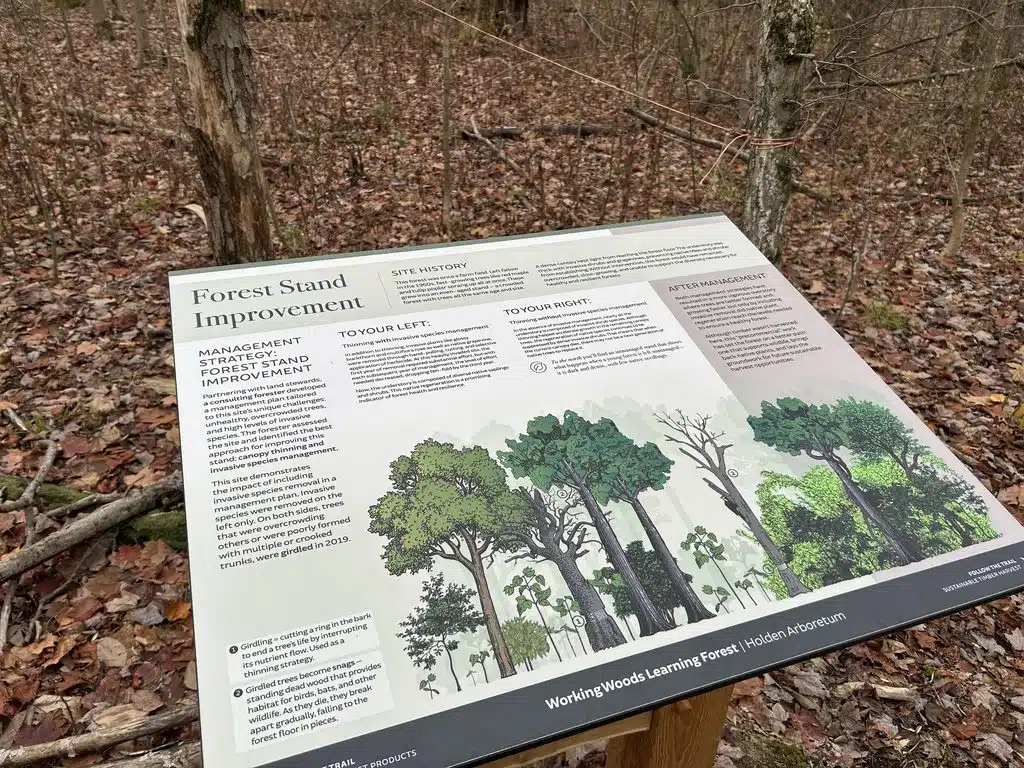
The Working Woods team uses strategies like sustainable timber harvest, single-tree selection cuts, invasive shrub control, and edge feathering to give native trees room to grow and to build a resilient forest with more species, ages, and layers. Most new trees come from natural regeneration, though some plots demonstrate underplanting of trees or native edible or medicinal plants. Since management began in 2018, the team has begun to see more native plant diversity, successful oak and hickory regeneration, more varied forest structure, and lower abundance of non-native species.
Landowners Shape Ohio’s Forests
More than 80% of Ohio’s forested land is privately owned, which means private landowners play a critical role in the health of the region’s forests. Working Woods was designed as a place where those landowners can see best practices for sustainable woodland management — straight from the plots where Holden scientists are putting those practices to the test.
“Working Woods allows us to generate new knowledge on best practices in forest management, and then immediately apply that knowledge to empower landowners to sustainably manage their own woodlands,” says Stuble. “It’s a great system for melding research and conservation to increase the effectiveness of both.”
Key partners have included the Ohio Department of Natural Resources Division of Forestry, the U.S. Forest Service, local Soil and Water Conservation Districts, and university researchers.
The Working Woods team has been busy. In 2025, they hosted 22 educational programs for more than 1,100 participants. The pilot for the new Holden Arboretum Consulting Forestry program completed 27 site visits and wrote seven forest management plans for landowners. Two miles of trails with interpretive signs, added in 2025, now let Arboretum visitors see the different management approaches on their own. And ecological research at the site has produced four scientific publications since 2023, on topics from understory biodiversity to the long-term effort needed to control invasive shrubs. As Working Woods has grown, they’ve been able to launch a restoration seed bank and a dedicated education and outreach position.
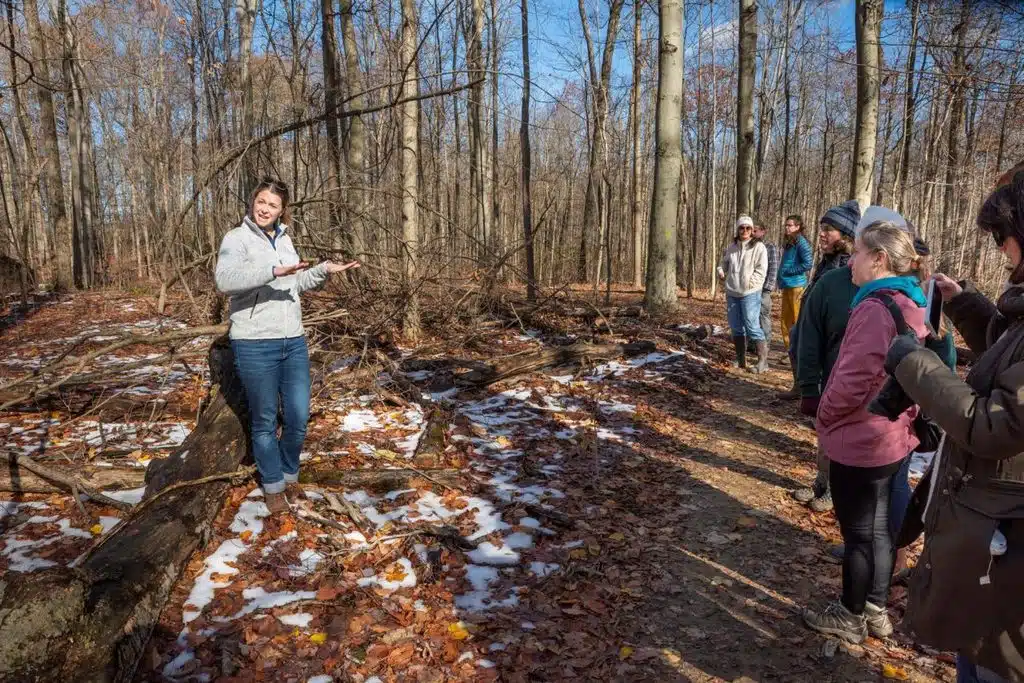
“Ultimately, we want our impact to extend far beyond Holden’s property lines. One organization can make a difference, but when organizations learn from one another, share successes, and build on each other’s work, we can multiply our impact and create meaningful change across entire landscapes,” says Troutman.
Restoring Forests Outside the Arboretum
A central argument of the BGCI report is that botanical gardens do great restoration work on their own grounds, but have far more to offer when that expertise can be put to use in a broader context. In the survey, about half of gardens reported doing restoration work within their own boundaries, and even fewer nearby. The report calls for gardens to share their knowledge and plant material with the people and partners restoring land everywhere else.
Working Woods is built around this idea. It brings together Holden’s research, conservation, and community forestry expertise to restore forest at the Arboretum, then it uses that forest to teach landowners, foresters, and other visitors from across the region how and why they might do the same on their own land. In a place where most forests are privately owned, like northeast Ohio, that kind of reach can matter as much as any acre restored at the Arboretum itself.
“Holden Arboretum is a great home for this kind of work because of the collaboration built into our organization. Community forestry, research, and horticulture bring different perspectives and expertise to the table, allowing us to put ideas into practice, learn from them, and share what works,” Troutman explains. And it’s working: as Troutman and Stuble write in the report, “Visitors frequently report leaving [Working Woods] with a deeper understanding of forest management and a desire to apply what they learn on their own land.”
Read the full BGCI report or visit the Working Woods Learning Forest at the Holden Arboretum.

Anna Funk, PhD
Science Communications Specialist
Anna Funk earned her Ph.D. studying prairie restoration ecology before leaving the research world to help tell scientists’ stories. Today, she is a writer and communications consultant for science and conservation organizations across the country.
Here’s more to explore

September 21, 2026
We’re on PBS! Learn more about Holden’s people and places seen on “By Nature’s Design”
The experts and forests of Holden Forests & Gardens appeared on the PBS Western Reserve’s docuseries, “BY NATURE’S DESIGN,” which premiered this weekend. Season 2, “Inside the Forests,” showcases a...
Read more
June 3, 2026
New Study Tracks Long-Term Results of Forest Fungi Restoration Experiment
Few places are as intensively landscaped as golf courses. They’re mowed and manicured, they’re fertilized and kept chemically weed-free, and they’re tromped on half the year by golfers, carts, and...
Read more
April 20, 2026
Ways to Love a Forest: Stories of Woodland Stewardship in Northeast Ohio
A logger had been coming by Joe and Christel Diliberto’s Portage County home for years, offering his services. So when they wanted a few trees removed — and he said...
Read more
January 6, 2026
Life in the Winter Forest
Take a stroll through the forest at the Holden Arboretum on a cold winter’s morning — the trails are open year-round — and the quiet stillness might trick you into...
Read more
November 20, 2025
Know the Forest Pests That Live in Your Area: Holden Researchers Get the Word Out
Do you know what the symptoms of beech leaf disease look like? What about hemlock woolly adelgid — can you tell it from elongate hemlock scale, and did you know...
Read more
September 17, 2025
Restoring Forests, Engaging Landowners, Advancing Science—All in One Place
A version of this article originally appeared on The Applied Ecologist. What would it look like to combine scientific research, public education, and ecosystem restoration all in one place? Less...
Read more
April 28, 2025
Study Shows Forest Soils Still Bear the Scars of Industrial Pollution
KIRTLAND, OHIO — After 12 years of carefully tracking tree growth and soil chemistry, researchers at Holden Forests & Gardens (HF&G) have confirmed that phosphorus is now a limiting nutrient...
Read more
April 25, 2025
Good News for Forests: Invasive Shrub Removal Gets Easier After Two Years of Work
KIRTLAND, OHIO — A new study from researchers at the Holden Arboretum offers encouraging news for forest managers battling non-native shrubs: the effort needed to control these invaders drops dramatically...
Read more
December 5, 2024
The Incredible Life Beneath Our Feet
World Soil Day is held annually on December 5th as a way to foster awareness for soil conservation. This year’s theme for World Soil Day is “Caring for Soils: Measure,...
Read more